


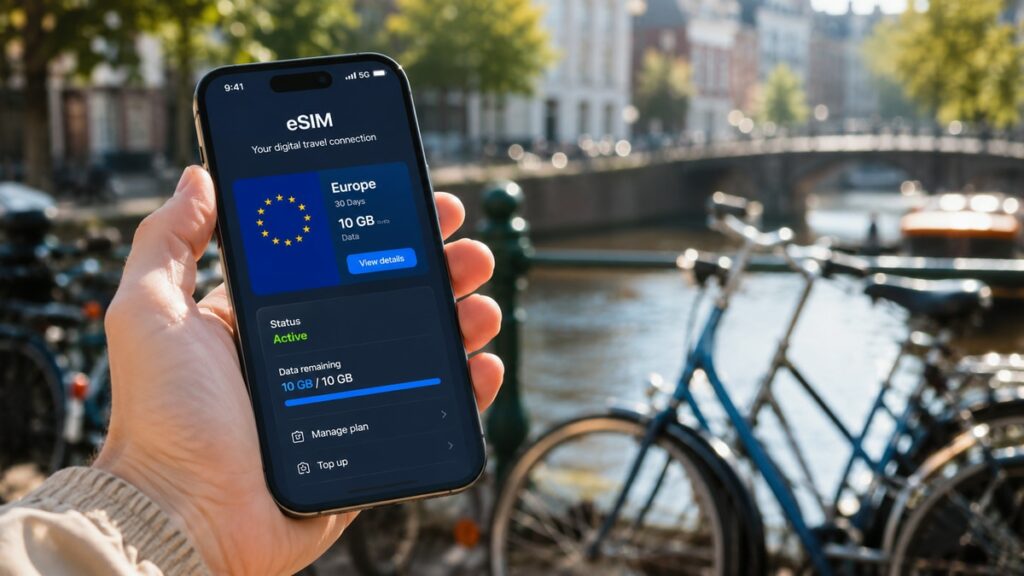
Travelling across Europe used to mean juggling SIM cards, hunting for kiosks in airports, or watching your bill explode when you crossed a border. Those days are behind us. In 2026, eSIMs have become the default option for anyone who lands in Madrid, hops to Lisbon, then catches a train to Berlin without missing a beat.
The market has exploded, though. A quick search returns dozens of providers, all promising the same thing: cheap data, wide coverage, fast 5G. The reality is messier. Some plans throttle after a few gigabytes. Others cover 25 countries instead of the 42 they claim. A handful actually deliver. Here are the ten that stand out this year, ranked on real-world coverage, pricing transparency, and the small details that make a difference once you are abroad.
1. Orange Travel
Orange Travel sits at the top of this list because it does something most competitors cannot: it operates its own network infrastructure across five European countries (France, Spain, Belgium, Poland, Romania) and partners with tier-1 carriers everywhere else. You are not buying from a reseller of a reseller. You are connecting directly to one of the strongest mobile groups on the continent.
The pricing is competitive too. Plans start at $4.99 for 1 GB over seven days, and unlimited data packages begin at €16.99 for five days with 30% off promotions running regularly. Hotspot sharing is included, refunds are honoured on unused plans, and 24/7 human support is available, not just chatbots.
Spain travelers in particular get a strong deal here. The eSIM for Spain connects to Orange, Movistar, Telefónica, Vodafone and Yoigo with 99% territory coverage, which means signal even in the Andalusian backcountry or the Balearic coastline. Unlimited plans go up to 25 days, perfect for longer stays.
Best for: Travelers who need reliable calls and SMS on top of data, and anyone heading specifically to Spain, France or Italy.
2. Airalo
Airalo built the eSIM marketplace category. It is now the most widely recognised name in the space, with plans in over 200 destinations and a Europe regional plan covering 42 countries (more than almost any competitor). The interface is clean, activation takes under five minutes, and there is a loyalty program that rewards frequent buyers.
Pricing leans toward data-light travelers. A 1 GB Europe plan runs around $4.50 for seven days. The 10 GB ten-day unlimited equivalent sits at $31.50. Speeds are solid on 5G in Western Europe, less consistent on certain MVNOs in Eastern markets.
Best for: Light to moderate users who plan multi-country itineraries and prioritise breadth of coverage over premium speed.
3. Holafly
Holafly carved out a niche by selling only unlimited plans. No gigabyte math, no overage anxiety. You pick a duration, you pay a flat price, you stream as much as you want. Founded in Spain in 2017, the company has grown into a global player with strong customer support and a simple, transparent product.
That simplicity has a cost. Holafly is rarely the cheapest option, especially for light users who would burn 2 GB in a week. But for content creators uploading videos daily, families streaming on the road, or remote workers in long video calls, the unlimited model pays for itself fast.
Best for: Heavy data users, families, content creators, anyone who hates checking their usage.
4. Ubigi
Ubigi flies under the radar but professionals know it well. Backed by Transatel (NTT Group), it operates as a full MVNO rather than a thin reseller. Translation: better speeds, better priority on networks, more stable connections in crowded urban areas where lesser providers get deprioritised.
The Europe plan covers 37 destinations with 5G in 34 of them, including monthly subscription options for digital nomads who stay longer. Plans start at $4.99 for 1 GB over seven days, and the unlimited data option for Europe sits among the most affordable on the market.
Best for: Business travelers, digital nomads, and anyone who values raw network quality over flashy marketing.
5. Saily
Saily comes from the NordVPN team, which tells you everything about its priorities. Privacy and security sit at the core of the product. The app includes a built-in ad blocker, a web protection feature that blocks malicious sites, and the polished user experience you would expect from a company that already runs one of the world’s biggest VPNs.
Europe coverage spans 35 countries with plans starting at $4.99 for 1 GB over seven days. Saily skips the Balkans (a gap if you are heading to Albania or North Macedonia) but covers everything else with reliable connections.
Best for: Privacy-conscious travelers, journalists, anyone handling sensitive data on public Wi-Fi.
6. Nomad
Nomad earned a reputation for aggressive pricing. The Europe plan covers 43 countries with 10 GB for $28, and shorter plans go as low as $18 for five days of unlimited data. The interface is straightforward, activation works as advertised, and 5G is available in most supported regions.
The downsides are real but manageable. Speeds are slightly below the top tier. Customer service reviews are mixed. Activation can occasionally lag during peak season. If you are price-sensitive and willing to accept those tradeoffs, Nomad delivers solid value.
Best for: Backpackers, students, budget travelers who want the lowest possible price per gigabyte.
7. Jetpac
Jetpac is the rising star. It covers 43 European countries (more than any other competitor) and adds features built for actual travel rather than just raw data. Free access to WhatsApp, Uber and Google Maps continues even when your data runs out, which sounds gimmicky until you are lost in Florence at midnight with an empty plan.
Optional add-ons include an in-app voice pack for outbound calls (rare in the eSIM world) and lounge access at major airports. Pricing sits in the mid-range, but the extras justify the cost for travelers who want more than just data.
Best for: First-time international travelers and anyone who appreciates safety nets when things go wrong.
8. Sim Local
Sim Local operates differently from the marketplace model. It connects directly to local providers in each country, which means real local speeds, no MVNO throttling, and genuinely unlimited data when the plan says unlimited. Coverage spans 30+ European countries with strong performance in remote backpacking spots.
The catch is fewer countries than aggregators like Airalo or Jetpac. But for travelers who pick depth over breadth, Sim Local delivers a near-native experience at a similar price point.
Best for: Travelers who want true local network speeds and unlimited data without throttling tricks.
9. GigSky
GigSky has been in the eSIM business since before most competitors existed. The company partners with cruise lines and luxury travel brands, which gives it a slightly different reputation in the market. The Europe coverage is solid (35+ countries), the network quality is high, and the customer service is responsive.
Pricing is on the higher side for what you get in terms of raw data. But GigSky’s stability on long trips and willingness to handle complex business accounts make it worth considering for corporate travelers or anyone planning a transatlantic itinerary that mixes Europe with a Mediterranean cruise.
Best for: Cruise passengers, business travelers, corporate accounts.
10. Roamless
Roamless is the newcomer worth watching. The provider uses a pay-as-you-go model rather than fixed plans: you load credit, you spend it only when you use data, and unused balance stays in your account. The model suits travelers who hate forecasting their own usage.
Coverage in Europe is improving fast, with most popular destinations supported and prices that compete with Nomad and Saily. The app is polished, the activation is instant, and there is no expiration date pressure pushing you to use everything before a deadline.
Best for: Occasional travelers, unpredictable itineraries, anyone tired of losing leftover data.
How do you actually choose between them?
Ten options is too many. Here is the shortcut. Ask yourself three questions before you buy.
First, how much data will you actually burn? Light users (maps, messaging, occasional photo uploads) burn 1 to 3 GB a week. Moderate users (social media, some streaming) hit 5 to 10 GB. Heavy users (video calls, streaming, hotspot for a laptop) push past 20 GB. If you fall in the heavy bucket, unlimited plans from Holafly or Orange Travel pay for themselves. If you are light, Airalo or Saily save you money.
Second, which countries are on your itinerary? Multi-country trips across 5+ borders favour regional plans with broad coverage (Airalo, Jetpac, Orange Travel). Single-country trips often work out cheaper with a local plan, especially in Spain, Italy, France or the UK where local eSIMs are aggressively priced.
Third, do you need calls and SMS? Most eSIMs are data-only. WhatsApp and FaceTime cover the gap for personal calls. But if you need a working number for hotels, taxis or local services, Orange Travel and Jetpac stand out as the few providers that handle voice properly.
A few practical tips before you install
Check your phone compatibility first. Most iPhones from the XS onward, Samsung Galaxy S20 and newer, and Google Pixel 3 and later support eSIM. Older Android models often do not. Two minutes on the manufacturer’s website saves you a refund request.
Install the eSIM before you board the plane. You will need a Wi-Fi connection to scan the QR code or activate via the app. Doing it at home is painless. Doing it in a foreign airport with no signal becomes a nightmare.
Turn off data roaming on your primary line. The whole point of an eSIM is to avoid roaming charges from your home carrier. If both lines stay active without that toggle, you risk paying twice for the same connection.
Finally, screenshot your eSIM QR code and activation details before you travel. Storing them in your email or photo library means you can reinstall the profile if your phone resets, without scrambling for support tickets while abroad.
The bottom line for European travel in 2026
The eSIM market has matured to the point where almost any traveler can find a plan that fits. The real question is not whether to use one but which provider matches your specific trip. Light users should look at Airalo or Saily. Heavy users should consider Holafly or Orange Travel. Business travelers gain from Ubigi or GigSky. Budget hunters lean Nomad. Privacy-first folks pick Saily.
Whatever you choose, the savings compared to traditional roaming are dramatic. A two-week European trip that would have cost $150 in roaming fees a few years ago now runs $20 to $40 on a decent eSIM plan. The technology has won. The only thing left is picking the right provider for the way you actually travel.