
Grid instability used to be rare. In 2026 it has become a seasonal event. The U.S. Department of Energy issued an emergency order under Section 202(c) of the Federal Power Act for the Mid-Atlantic grid in January, during Winter Storm Fern. It issued another order in May and two more at the end of June, as heat waves pushed PJM Interconnection toward record peak demand. Winter storm, then summer heat wave, then summer heat wave again: these emergencies keep happening on a schedule now, not as isolated events.
The pattern lines up with the broader reliability picture. Aging infrastructure, extreme weather, and rising electricity demand from data centers and electrification are pushing outage risk higher across the country. The North American Electric Reliability Corporation’s own assessments have flagged elevated risk in more than half of U.S. grid regions. Power outages already cost Americans an estimated $44 billion a year, according to DOE’s National Laboratories.
Coverage of that trend usually stops at the refrigerator and the air conditioner. Almost none of it asks what happens to the home security system during that same outage.
What Happens When the Power Goes
A security system that loses power doesn’t necessarily go dark. Control panels typically run on backup battery for a stretch after an outage begins, and cameras and sensors with their own batteries keep operating independently of the panel. Whether the system stays useful comes down to one thing: whether it can still reach a monitoring center once the home’s main connection is gone.
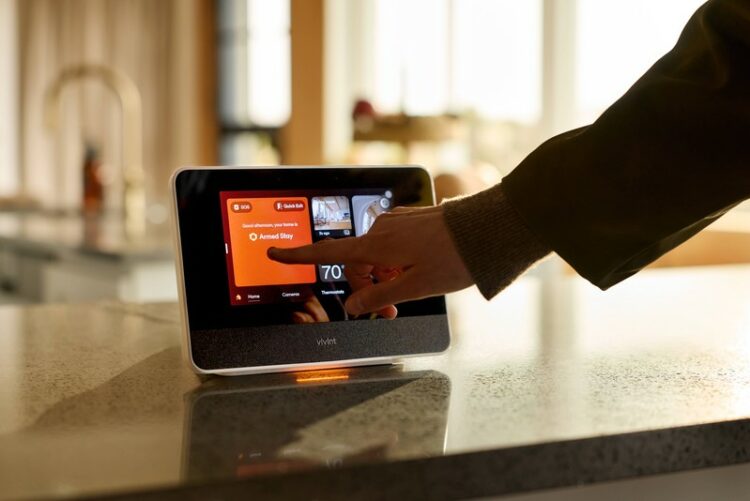
A panel that talks to the monitoring center over a home’s internet connection loses that link the moment the router loses power. Every Vivint Smart Hub includes built-in cellular connectivity and battery backup, so the panel keeps talking to the monitoring center regardless of what’s happening to the home’s Wi-Fi or power.
What Happens When the Wi-Fi Goes, Even if the Power Doesn’t
Power and internet don’t always fail together. A router can drop, an internet provider can have an outage, or a modem can simply need a reset, all while the lights stay on. For a security system built around Wi-Fi and a cloud connection, that’s functionally the same failure as a blackout: the notifications stop, and the monitoring center loses its link to the house.
On-device processing limits the damage from that failure. Vivint’s Smart Deter™ runs its person and package detection on the camera itself, not in the cloud, which means the detection and the light-and-sound response still fire even when the home’s internet connection is down. A working Wi-Fi network isn’t what triggers the deterrent. It’s only needed afterward, to send the homeowner a notification about what happened.
Cellular backup and on-device processing solve two different halves of the same problem, and they don’t overlap. Cellular backup is what keeps the system talking to the monitoring center during an actual power outage, since the hub runs on battery backup while a powered camera does not. On-device processing solves a narrower problem: a Wi-Fi or internet outage with the power still on, where a camera can still run its own detection and deterrence even though it has lost its connection to the outside world.
Homeowners weighing a security system rarely ask what happens during an outage until the outage happens.
Learn more about Vivint
Backup battery and cellular-first monitoring come standard on every Vivint system, and any Vivint camera in that system runs its detection on-device, set up by the company’s own technicians and paired with 24/7 professional monitoring.