

In the e-commerce industry, the distance between a product and a customer is entirely visual. Unlike physical retail, where customers can handle merchandise, assess quality directly, and engage with store staff, online shoppers make purchase decisions based almost exclusively on how a product looks on screen. Product imagery isn’t a marketing asset in the traditional sense — it’s the primary interface through which customers evaluate whether to trust a product enough to buy it.
The implications for e-commerce operations are significant. Poor product imagery doesn’t just reduce conversion rates — it increases return rates, drives up customer service inquiry volume, and erodes the brand trust that underpins long-term customer lifetime value. Businesses that manage large product catalogs understand this well: visual content quality is a customer experience variable as much as it is a production challenge, and the two can’t be separated in practice.
The operational challenge is scale. Producing professional product imagery for a large or rapidly growing catalog through traditional photography requires studio coordination, photographer scheduling, post-production time, and per-image costs that compound quickly as catalog size increases. For businesses managing thousands of SKUs across multiple channels, maintaining consistent visual quality across the full catalog has historically been either expensive or inconsistent — or both.
AI Product Photo Suite: Solving the Scale Problem Directly
The practical answer to catalog-scale product imagery production is AI generation — specifically, tools that take existing product photographs as input and generate the full range of professional visual assets a listing requires: clean studio shots with configurable backgrounds, lifestyle images that show the product in context, model photography for wearable items, and promotional poster compositions for marketing use.
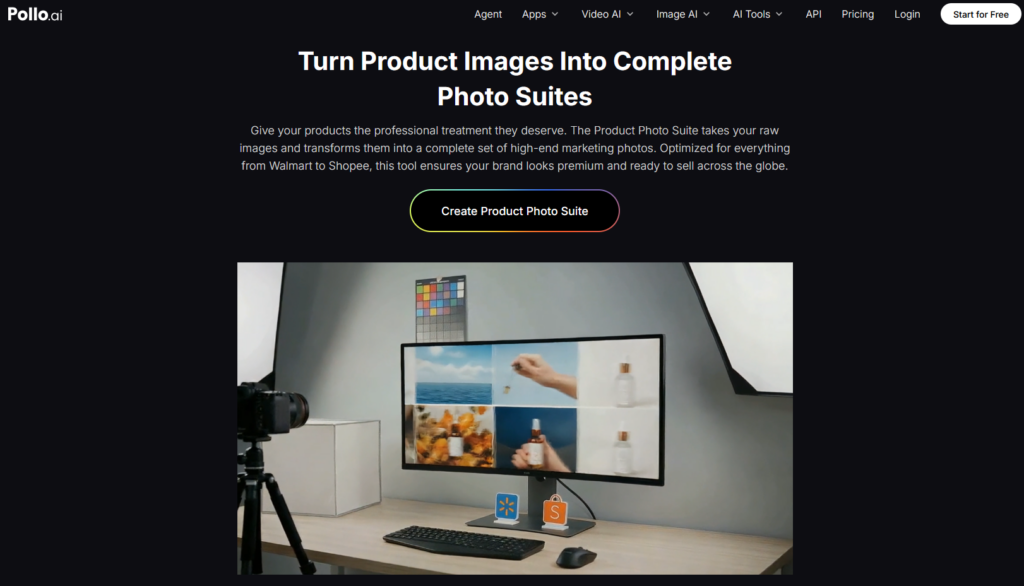
Pollo AI’s AI Product Photo Suite inside its Commerce Studio is designed for exactly this production challenge. The tool generates professional product imagery from source photographs without studio setups or post-production overhead, and does so across the range of image types that professional e-commerce listings require rather than producing a single output format. For operations teams managing catalog updates, seasonal refreshes, or new product launches at volume, the production time reduction is substantial — assets that previously required days of coordination can be generated within hours.
The consistency dimension matters as much as the speed dimension for e-commerce operations. Visual consistency across a product catalog — where all images share the same lighting approach, background treatment, and compositional style — signals professionalism and brand coherence to customers in ways that directly influence purchase confidence. AI generation from a consistent aesthetic specification produces this consistency across a large catalog more reliably than coordinating multiple photography sessions over time with potentially varying production conditions.
Pollo AI’s shared credit system connects the Commerce Studio’s product imagery capabilities to its Marketing Studio for advertising content and Creative Studio for general visual production — which means the product images generated for catalog listings can feed directly into promotional and advertising workflows without platform switching or asset reconstruction.
The Customer Experience Connection: How Visual Quality Affects Post-Purchase Behavior
The relationship between product imagery quality and customer experience extends beyond the initial purchase decision into post-purchase behavior — a connection that is particularly relevant for businesses focused on customer service operations and retention metrics.
Accurate, high-quality product imagery reduces the gap between customer expectation and product reality. When a customer’s received product matches the visual representation they made their purchase decision from, return rates decline and customer satisfaction scores improve. Conversely, when product imagery is misleading — whether through poor quality, inaccurate color representation, or missing contextual information about size and scale — the resulting disappointment generates return requests, negative reviews, and customer service inquiries that have real operational costs.
For businesses that outsource customer support or manage contact center operations, this connection is financially concrete. Every preventable return and inquiry driven by inadequate product imagery represents a cost that sits downstream of a visual content production decision. Investing in higher-quality product imagery through AI generation tools pays dividends across the customer lifecycle, not just at the point of conversion.
Commerce and Marketing Integration: The Full Visual Production Workflow
Effective e-commerce visual content production doesn’t end with product listing imagery. The same product assets need to serve advertising campaigns, email marketing, social media content, and promotional materials — each with different format requirements, aesthetic contexts, and audience expectations. Managing this visual content workflow across multiple production tools and vendor relationships creates coordination overhead that compounds as business scale increases.
Pollo AI’s Marketing Studio addresses the advertising content side of this workflow, producing platform-ready video and image ad creative within the same platform where product imagery is generated in the Commerce Studio. For e-commerce operations teams thinking about visual content production holistically, the ability to manage product photography, advertising creative, and promotional content through a single platform relationship with shared credits simplifies the operational landscape meaningfully.
Kaze AI and Evaluating Your Options
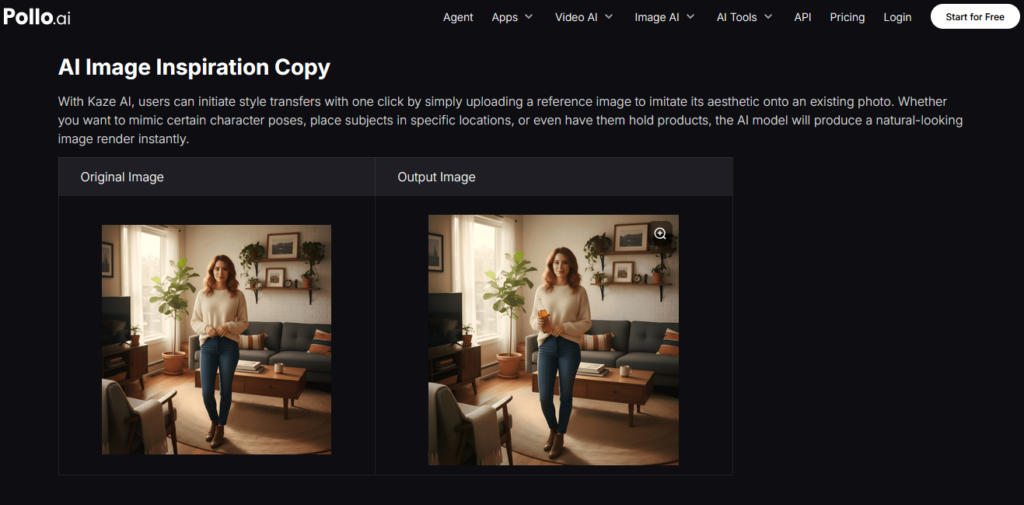
Understanding the range of available AI image generation tools helps operations and marketing teams make better-informed decisions about which capabilities fit their specific workflow requirements. Kaze AI offers AI image generation with its own model characteristics and aesthetic approach, suitable for certain creative and stylistic applications. For teams evaluating options across the AI image generation landscape, testing outputs from different platforms against your specific product categories and visual standards — rather than relying on general capability comparisons — produces the most reliable picture of real-world fit.
The evaluation criterion that matters most for e-commerce product imagery specifically is consistency of output quality across varied product types and input photograph conditions. A tool that produces excellent results for one product category may underperform for another, and a platform’s performance on carefully curated demo inputs may not predict its performance on the full range of products in your catalog. Pollo AI’s multi-model approach within the Commerce Studio addresses this variability by allowing different generation models to be applied to different product types based on their specific strengths.
Building a Scalable Visual Content Operation
The e-commerce businesses that manage visual content production most effectively in 2026 have made a structural shift in how they approach the challenge — treating AI generation as the default production method for standard catalog content rather than a supplement to traditional photography. This reallocation frees traditional photography budget and effort for hero creative content that genuinely benefits from human direction and production quality, while AI handles the volume work that makes up the majority of catalog content needs.
For operations teams focused on efficiency, cost management, and customer experience metrics, this structural approach to visual content production connects directly to the business outcomes they’re responsible for. Lower per-image production costs, faster catalog update cycles, more consistent visual quality across the full product range, and reduced downstream customer service costs from clearer product representation — these are the measurable outcomes that make AI product photo generation a genuine operational investment rather than a marketing experiment.